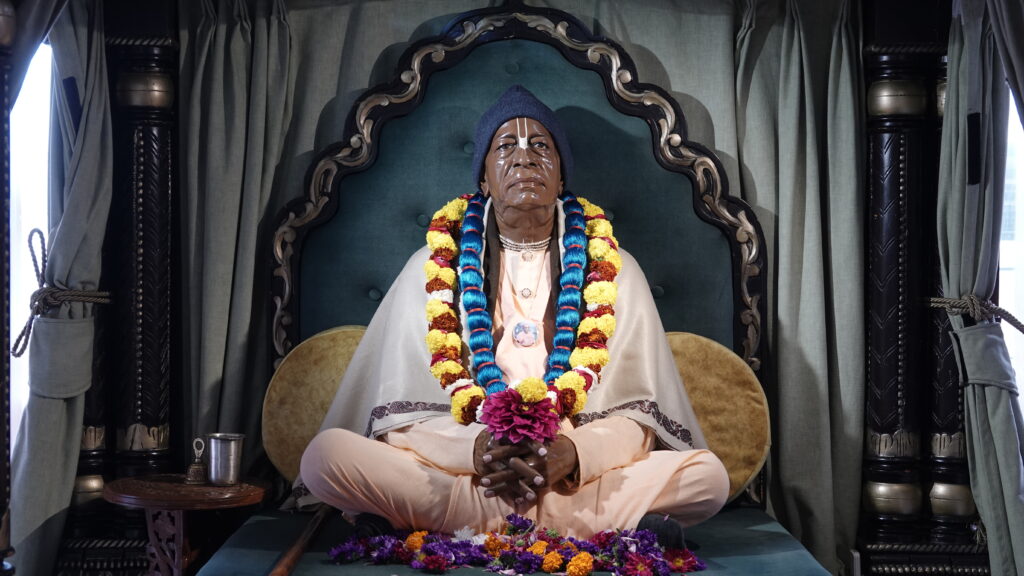
A. C. Bhaktivedanta Swami Prabhupada, lovingly known as Srila Prabhupada, was a spiritual visionary whose teachings seamlessly integrated profound philosophy with practical compassion for humanity. Among his many instructions to his followers, one of the most impactful and socially relevant was his desire that no one should go hungry within a 10-mile radius of any Hare Krishna temple. This was not a symbolic or rhetorical statement; it was a direct and actionable mandate rooted in his deep concern for human welfare and his understanding of true spiritual responsibility. Srila Prabhupada saw hunger not merely as a physical deprivation but as a reflection of society’s neglect of its moral and spiritual duties. For him, ensuring that people are fed was an essential expression of devotion and service to God.
Central to this instruction is the principle of prasadam—sanctified food that is first prepared with purity, offered to the Lord with devotion, and then distributed to others. Srila Prabhupada emphasized that such food carries spiritual potency, nourishing both the body and the consciousness. By distributing prasadam widely, especially to those in need, his followers could address material hunger while simultaneously uplifting individuals spiritually. This transforms the simple act of feeding into a sacred service, aligning it with the broader mission of spreading Krishna consciousness. Thus, his directive to eliminate hunger within a 10-mile radius becomes a practical application of spiritual philosophy in everyday life.
What makes this instruction particularly remarkable is its clarity and practicality. By specifying a 10-mile radius, Srila Prabhupada established a localized framework of responsibility. Each Hare Krishna temple was entrusted with the duty of ensuring that no one in its surrounding area would remain hungry. This approach decentralizes the effort to combat hunger, making it both manageable and effective. Instead of viewing hunger as an overwhelming global issue, it becomes a series of community-level responsibilities. Each temple and its congregation become accountable for the well-being of their immediate environment, creating a network of care that can collectively have a far-reaching impact.
Furthermore, Srila Prabhupada’s vision was deeply inclusive. His instruction did not discriminate based on caste, creed, religion, nationality, or social status. Anyone who is hungry deserves to be fed—this was the essence of his teaching. This universal outlook reflects the Vedic principle of working for the welfare of all living beings. By encouraging unconditional food distribution, he broke down social barriers and promoted equality through service. In a world often divided by differences, his vision fosters unity by addressing a fundamental human need—food.
The real-world implementation of this instruction can be seen in various food relief initiatives inspired by his teachings. Across the globe, devotees and volunteers organize prasadam distribution programs, community kitchens, and feeding drives in hospitals, orphanages, old age homes, and underserved communities. These efforts are carried out with dedication and discipline, ensuring that food is not only nutritious but also prepared and served with devotion and respect. Many of these initiatives go beyond the 10-mile radius, expanding their reach to serve larger populations, especially during times of crisis such as natural disasters or economic hardship. In this way, Srila Prabhupada’s vision continues to manifest as a living, dynamic force for good.
This instruction also serves as a guiding principle for individuals and organizations seeking to make a meaningful difference. It challenges us to reflect on our role in society and consider how we can contribute to alleviating hunger. Whether through direct service, supporting feeding programs, or minimizing food waste, each action becomes part of a larger mission. Srila Prabhupada’s emphasis on feeding the hungry reminds us that spirituality is not limited to personal practice but extends to compassionate action and social responsibility.
In conclusion, Srila Prabhupada’s desire that no one should starve within a 10-mile radius of any Hare Krishna temple represents a powerful synthesis of spiritual wisdom and humanitarian service. It calls for a world where compassion is actively practiced, where communities take responsibility for one another, and where no individual is left to suffer from hunger. His vision continues to inspire countless initiatives and individuals, demonstrating that even a simple act like sharing food can become a profound expression of divine love and service.